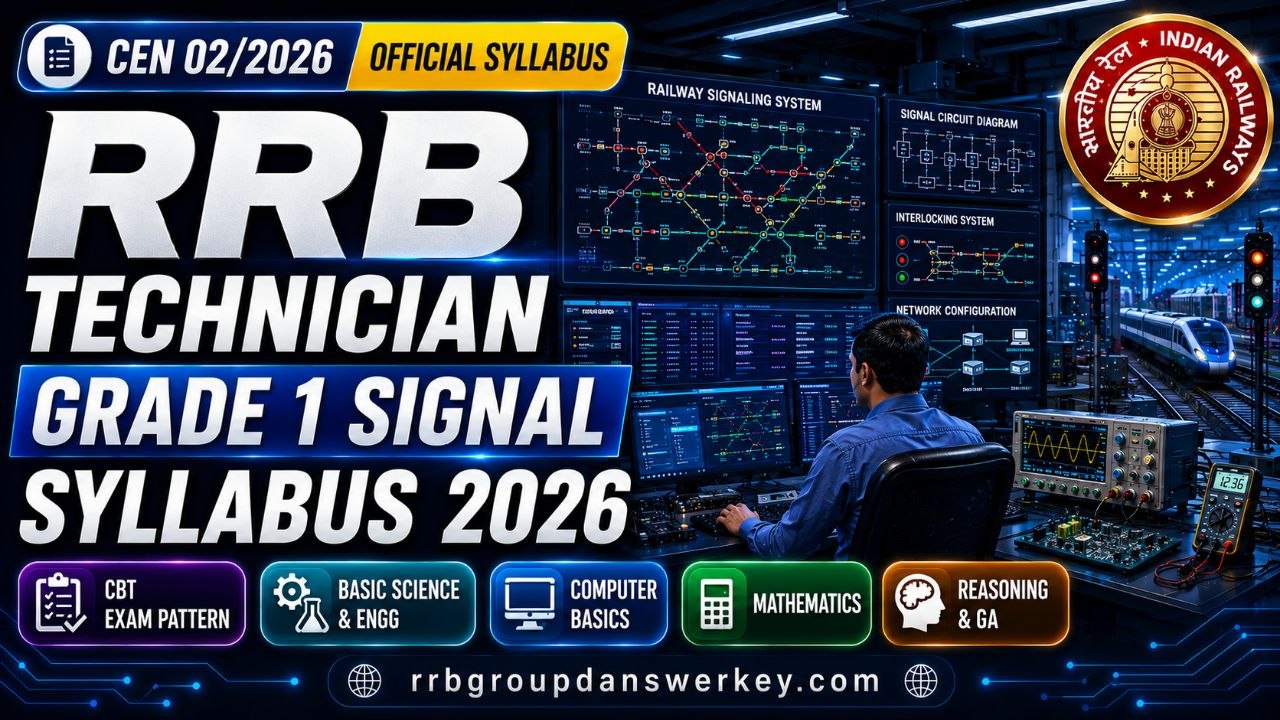
To successfully clear the Railway Recruitment Board (RRB) Technician Grade-I Signal examination under Centralized Employment Notification (CEN) No. 02/2026, candidates must possess a comprehensive understanding of the prescribed syllabus and examination pattern. The Technician Grade-I Signal position is a Level-5 post under the 7th Central Pay Commission (CPC) carrying an initial pay of Rs. 29,200/- per month. Because this post involves critical signal maintenance, telemetry, and electronic safety operations, the Computer Based Test (CBT) evaluates advanced scientific concepts, computer fundamentals, and technical reasoning.
The selection process for Technician Grade-I Signal comprises a single-stage Computer Based Test (CBT), followed by Document Verification (DV) and a B-1 Medical Fitness Examination. Below is a detailed, section-by-section breakdown of the official syllabus, subject weightage, negative marking rules, and preparation strategies derived directly from the official CEN 02/2026 notification.
Table of Contents (Syllabus Index)
- 1. Selection Stages & Qualification Criteria
- 2. CBT Exam Pattern & Subject Weightage
- 3. General Awareness Detailed Topics
- 4. General Intelligence & Reasoning Detailed Topics
- 5. Basics of Computers & Applications Detailed Topics
- 6. Mathematics & Technical Calculation Detailed Topics
- 7. Basic Science & Engineering Detailed Topics (35 Marks)
- 8. Preparation Strategy & Subject Study Plan
- 9. Frequently Asked Questions (FAQs)
1. Selection Stages & Qualification Criteria
The recruitment drive for RRB Technician Grade-I Signal (Category No. 1) follows a rigorous 3-tier selection process to ensure candidates meet the high technical and operational standards of Indian Railways:
| Recruitment Stage | Nature of Assessment | Evaluation Weightage | Key Qualifying Conditions |
|---|---|---|---|
| 1. Computer Based Test (CBT) | Single-Stage Objective Multiple Choice Examination (100 Questions) | 100% Weightage for shortlisting to DV | Shortlisting for Document Verification is done at a 1:1 ratio based on normalized CBT merit. Minimum qualifying percentage applies. |
| 2. Document Verification (DV) | Original Certificate & Credentials Scrutiny | Qualifying Only | Verification of educational certificates (B.Sc / Diploma / B.Tech degree), Caste/Category, DOB, and ID proofs. |
| 3. Medical Examination (ME) | B-1 Standard Health & Visual Fitness Test | Qualifying Only | Distant vision 6/9, 6/9 with or without glasses (Max power 4D). Near vision Sn 0.6, 0.6. Must pass Color, Binocular, Night & Myopic vision tests. Candidates with LASIK surgery are disqualified. |
2. CBT Exam Pattern & Subject Weightage
The CBT for Technician Grade-I Signal carries 100 questions to be attempted in 90 minutes. Below is the official subject-wise mark distribution and exam rules:
| Subject / Exam Section | Number of Questions | Maximum Marks | Negative Marking & Qualifying Rules |
|---|---|---|---|
| General Awareness | 10 Questions | 10 Marks | * Total Exam Duration: 90 Minutes (1.5 Hours) * Negative Marking: 1/3rd (0.33) mark deduction for each incorrect answer. * Question Languages: Available in English, Hindi, and 13 regional Indian languages. * Normalization: CBT scores normalized across multi-session exams. * Minimum Qualifying Marks: UR/EWS: 40%, OBC (NCL): 30%, SC: 30%, ST: 25%. |
| General Intelligence & Reasoning | 15 Questions | 15 Marks | |
| Basics of Computers & Applications | 20 Questions | 20 Marks | |
| Mathematics | 20 Questions | 20 Marks | |
| Basic Science & Engineering | 35 Questions | 35 Marks | |
| Total CBT Weightage | 100 Questions | 100 Marks |
3. General Awareness Detailed Topics
This section carries 10 marks and evaluates a candidate's awareness of current national events, scientific breakthroughs, and historical context:
| Sub-Topic Area | Detailed Syllabus Coverage |
|---|---|
| Current Affairs | National & International events, Government Schemes, Rail Infrastructure updates, Awards, Summits, and Policy changes. |
| Indian Polity & Constitution | Fundamental Rights, Preamble, Parliament, Constitutional bodies, Executive structure, and recent legislative amendments. |
| Indian History & Freedom Movement | Modern Indian History, 1857 Revolt, Indian National Congress sessions, Independence struggle, and prominent leaders. |
| Geography & Economy | Physical geography of India, Rivers, Mountains, Climate, Economic planning, Union Budget highlights, and GST basics. |
| Sports & Culture | Major sports tournaments, Olympic events, Indian classical dances, festivals, heritage sites, and literature awards. |
4. General Intelligence & Reasoning Detailed Topics
Carrying 15 marks, this section tests logical reasoning, pattern recognition, and decision-making capabilities:
| Topic Category | Sub-Topics & Question Types Covered |
|---|---|
| Analogies & Classification | Number Analogies, Letter/Word Analogies, Odd One Out, Semantic Classifications. |
| Series & Sequences | Number Series, Alphabet Series, Mixed Sequences, Missing Number Puzzles. |
| Coding & Decoding | Letter Coding, Number Substitution, Matrix Coding, Deciphering message statements. |
| Mathematical Logic & Syllogisms | Mathematical Operators, Venn Diagrams, Syllogisms (Statement & Conclusions), Binary Logic. |
| Analytical & Directional Reasoning | Blood Relations, Direction Sense Tests, Seating Arrangements, Statement-Arguments & Assumptions. |
5. Basics of Computers & Applications Detailed Topics
Carrying 20 marks, this dedicated computer section evaluates fundamental IT knowledge essential for computerized railway signal management systems:
| Computer Module | Syllabus Topics & Core Concepts |
|---|---|
| Computer Architecture & Hardware | CPU components (ALU, Control Unit), Input/Output devices (Scanners, Printers, Keyboards), Storage devices (RAM, ROM, HDD, SSD, Flash memory). |
| Operating Systems | Functions of OS, File Management, Windows OS concepts, Unix, Linux, Memory Management, Process Control. |
| MS Office Suite | MS Word (formatting, shortcuts), MS Excel (spreadsheets, formulas, charts), MS PowerPoint (slides, transitions). |
| Data Representation | Binary, Octal, Decimal, and Hexadecimal conversion systems, ASCII and Unicode encodings. |
| Networking & Internet | OSI Model layers, IP Addressing, Routers, Switches, LAN/WAN, Web Browsers, Protocols (HTTP, HTTPS, FTP, TCP/IP). |
| Cyber Security & Malware | Computer Viruses, Worms, Trojan Horses, Firewalls, Antivirus tools, Phishing, Encryption fundamentals. |
6. Mathematics & Technical Calculation Detailed Topics
Carrying 20 marks, the Mathematics section covers numerical calculations, algebraic techniques, and higher secondary mathematical foundations:
| Mathematical Branch | Detailed Syllabus Topics |
|---|---|
| Arithmetic & Number Systems | Number System, Rational & Irrational Numbers, BODMAS, Decimals, Fractions, LCM & HCF, Ratios, Percentages, Averages. |
| Commercial Mathematics | Profit & Loss, Simple & Compound Interest, Time & Work, Pipes & Cisterns, Time & Distance, Speed calculations. |
| Algebra & Mensuration | Basic Algebraic Identities, Linear Equations, Quadratic Equations, Polynomials, Area & Volume of 2D/3D shapes. |
| Trigonometry & Statistics | Heights & Distances, Trigonometric Ratios & Identities, Mean, Median, Mode, Standard Deviation, Elementary Probability. |
| Advanced Topics | Matrices and Determinants (Addition, Multiplication, Transpose, Determinant values, Inverse of matrices). |
7. Basic Science & Engineering Detailed Topics (35 Marks)
This is the most critical section of the exam, accounting for 35% of total CBT marks. It focuses heavily on basic engineering physics, electrical circuits, and electronics:
| Engineering Science Branch | Detailed Syllabus Topics & Core Themes |
|---|---|
| Engineering Mechanics & Physics | Units and Measurements, Mass, Weight and Density, Work, Power and Energy, Speed and Velocity, Heat and Temperature, Thermal Expansion, Force and Laws of Motion, Friction. |
| Basic Electricity & DC Circuits | Electric Current, Voltage, Resistance, Conductance, Ohm’s Law, Kirchhoff’s Voltage & Current Laws (KVL/KCL), Series and Parallel Circuits, Capacitors, Inductors, Electromagnetism, Magnetic Circuits. |
| Basic Electronics & Semiconductors | Energy Band Theory, Intrinsic and Extrinsic Semiconductors, P-N Junction Diodes, Zener Diodes, Rectifiers, Transistors (BJT, FET, MOSFET), Operational Amplifiers (Op-Amps), Inverting and Non-Inverting Amplifiers. |
| Digital Electronics | Logic Gates (AND, OR, NOT, NAND, NOR, XOR, XNOR), Boolean Algebra, De Morgan’s Theorems, Combinational Logic Circuits (Adders, Subtractors, Multiplexers), Sequential Circuits (Flip-flops, Registers, Counters). |
| Signals, Systems & Telecommunication | Analog and Digital Signals, Modulation techniques (AM, FM, PM), Sampling theorem, Communication systems basics, Transducers, Measurements and Electronic Test Instrumentation (CRO, Multimeters, Signal Generators). |
8. Preparation Strategy & Subject Study Plan
- Prioritize Basic Science & Engineering: Allocate at least 40% of your daily study time to engineering physics, basic electronics, and digital circuits, as this single section carries 35 marks.
- Master Computer Applications: Focus on MS Office shortcuts, networking protocols, and binary conversions to easily score in the 20-mark computer section.
- Accuracy & Negative Marking Control: Since 1/3rd mark is deducted for incorrect responses, practice timed mock tests to eliminate guessing habits.
- Target Normalized Cut-Offs: Practice previous year RRB papers to build speed for completing 100 questions within the 90-minute limit.
9. Frequently Asked Questions (FAQs)
Q1. What is the total duration and mark count of RRB Technician Grade-I Signal CBT?
The CBT exam consists of 100 questions for 100 marks, with a total time duration of 90 minutes.
Q2. Which subject carries the highest weightage in Grade-I Signal syllabus?
Basic Science & Engineering carries the highest weightage with 35 questions (35 marks).
Q3. Is there negative marking in Technician Grade-I Signal CBT?
Yes, 1/3rd (0.33) of the allocated marks will be deducted for each incorrect answer.
Q4. Are Matrices and Determinants included in the Mathematics syllabus?
Yes, basic concepts of Matrices and Determinants are explicitly included in the official CEN 02/2026 Mathematics syllabus for Grade-I Signal.